How to Onboard a New Shed Dealer in Under a Week
Most manufacturers take 3–4 weeks to get a new dealer productive. The ones doing it in days built a better system — here's how.
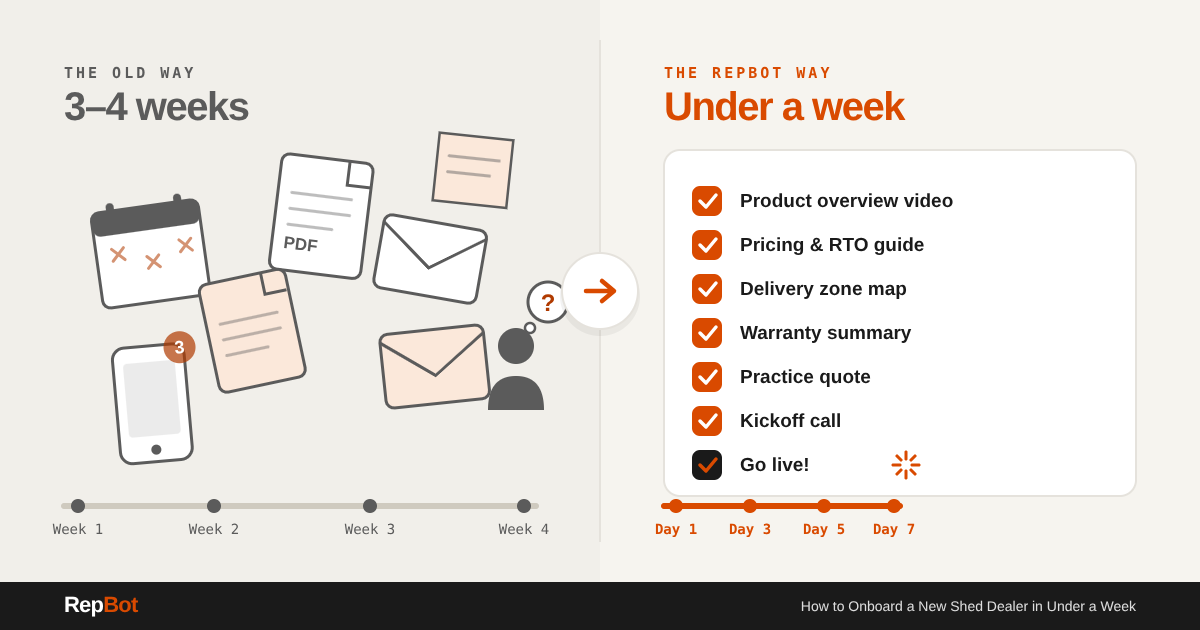
Adding a new dealer to your network should be exciting. New territory, new customers, new revenue. Instead, for most manufacturers, it’s three weeks of back-and-forth emails, scheduled training calls that get postponed, and a dealer who goes live still not knowing half of what they need to know.
It doesn’t have to work that way.
Why traditional onboarding takes so long
The typical manufacturer onboarding process looks something like this:
Week one: send a welcome email with a ZIP file of documents. Wait for the dealer to open it, get confused, and email back with questions.
Week two: schedule a product training call. The dealer cancels once, then joins late. Cover half the material. Promise to send notes.
Week three: send the notes. Realize you forgot to cover RTO programs. Schedule another call. Dealer goes “live” still fuzzy on delivery zones.
Week four: first customer question the dealer can’t answer. They call your rep. Your rep re-explains something that was in the ZIP file.
The problem isn’t effort. Manufacturers put genuine time into onboarding. The problem is that the process is unstructured, asynchronous in the wrong ways, and entirely dependent on a human rep being available at the right moment.
The five things every dealer needs before their first sale
Before a dealer can confidently sell your product, they need to know five things. Not ten. Not twenty. Five.
- Your product line at a glance. What do you build, in what sizes, and what are the key differences between models? Dealers don’t need to memorize specs — they need a mental map of the catalog.
- How pricing and RTO work. What’s the base price structure? Which models qualify for rent-to-own? What are the standard terms? This is the most common source of dealer uncertainty on the lot.
- Delivery zones and lead times. Where do you deliver, what does it cost, and how long does it take? These questions come up in nearly every customer conversation.
- Warranty basics. What’s covered, for how long, and what does a dealer tell a customer when something goes wrong? Dealers who can’t answer warranty questions lose trust fast.
- How to get help. Who do they call? What can they look up themselves? Where does escalation go? A dealer who knows exactly how to get an answer in 30 seconds sells more confidently than one who has to guess.
What a fast onboarding system looks like
The manufacturers onboarding dealers in under a week have one thing in common: they’ve separated the content from the conversation.
Content — product specs, pricing guides, RTO terms, delivery maps, warranty documents — is available on-demand, 24/7, self-serve. A dealer can go through it at 10pm on a Sunday if that’s when they have time.
Conversation — the rep call, the Q&A, the relationship-building — happens once, briefly, after the dealer has already reviewed the material. Instead of using the call to transfer information, you’re using it to confirm understanding and answer the 2–3 questions that actually needed a human.
This flips the sequence. Instead of: Call first → send documents → follow-up call → go live (3–4 weeks) — you get: Send structured content → dealer self-onboards → short confirmation call → go live (days, not months).
The checklist that makes it work
A structured onboarding checklist changes the dealer’s experience from “I received a bunch of files” to “I’m working through a clear process.”
A good dealer onboarding checklist has five to seven steps, each one a specific action with a clear completion state:
- Watch the product line overview (12-minute video)
- Read the pricing and RTO guide
- Review the delivery zone map for your territory
- Read the warranty terms summary
- Complete the product knowledge quiz (optional but effective)
- Join the 20-minute kickoff call with your rep
- Place your first practice quote
When dealers can see their progress through a defined process, they move faster. And when you can see which dealers have completed which steps, you know exactly where to follow up.
What happens after go-live matters too
Onboarding doesn’t end when the dealer opens their lot. The first 30 days are when the real questions come — and how fast they get answered determines whether a new dealer becomes a confident seller or a low-volume afterthought.
The manufacturers with the strongest dealer networks have figured out that post-launch support is part of onboarding. A dealer who gets a fast, accurate answer to their first five hard questions will be a better dealer for years. A dealer who waits two days for each answer will calibrate their expectations accordingly.
The ROI of a faster onboarding process
If onboarding takes 3 weeks instead of 1 week, you lose roughly 2 weeks of potential dealer sales per new dealer. For a dealer averaging $15,000 in monthly revenue, that’s $7,500 in delayed revenue per dealer.
If you add 12 new dealers a year, that delay costs you roughly $90,000 in revenue that could have arrived 2 weeks earlier — every single year.
A faster, more structured onboarding process doesn’t just feel better. It pays for itself quickly.
RepBot includes a built-in dealer onboarding hub with structured checklists, progress tracking, and self-serve content access. Most manufacturers using RepBot get new dealers productive fast.